

Technology

Explore Q-Biotech's R&D capabilities, patents, and certifications driving innovation in wastewater treatment.

High-Concentration Wastewater Pretreatment System (QBR)

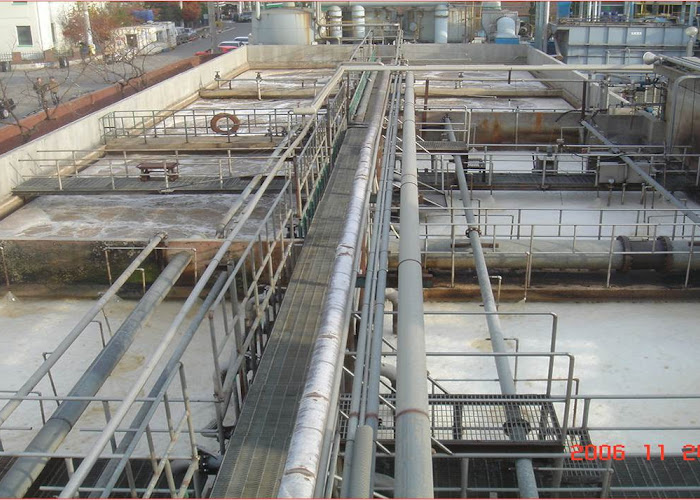
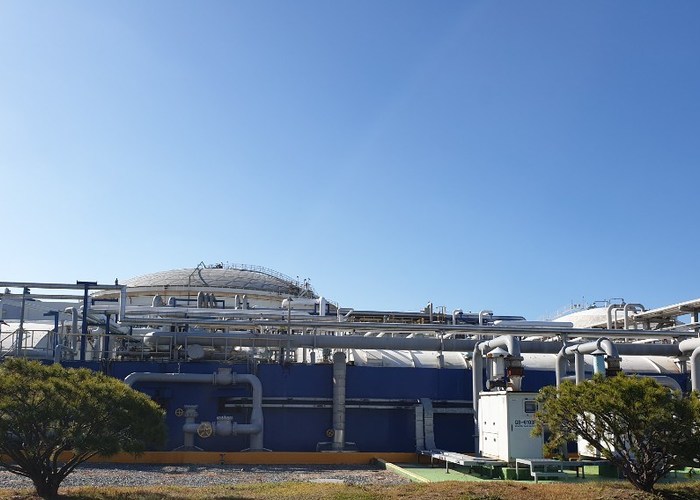
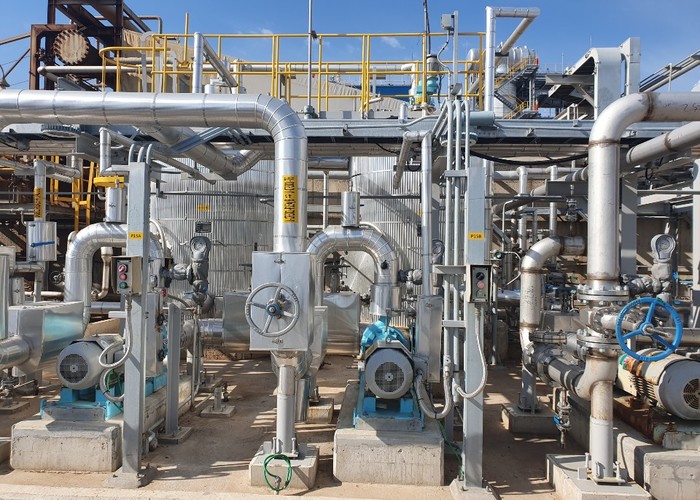
QBR (Quick Bio Reactor) is a new-concept biological pretreatment process that economically treats high-concentration hazardous wastewater — which is difficult to treat by conventional biological methods — to the level of ordinary wastewater.

Through the application of microbial activity monitoring technology, this is Q-BioTech's proprietary system engineered for more stable operation. It is a proven technology applied at numerous petrochemical and fine chemical plants.

The QBR SYSTEM is subdivided into QBR, QNBR, QSBR, and QHBR depending on the wastewater characteristics.

Technical Features

  • Over 10x the organic matter treatment load compared to conventional activated sludge
  • High microbial activity stability — resilient to influent load shocks
  • Site-specific customized bacteria development and application
  • Environmentally friendly technology with no secondary pollution
  • Microbial activity system (Feed Cut) operational monitoring — real-time microbial activity confirmation

Target Applications

  • Wastewater that is difficult to treat at conventional sewage and wastewater treatment plants
  • Incineration-treated wastewater, high-cost chemical wastewater, toxic wastewater, recalcitrant wastewater
  • Nitrogen wastewater, high-salinity wastewater, petroleum and paper industry wastewater
  • Phenol-containing wastewater, fluoride and cyanide-containing wastewater
  • When facility expansion is needed due to insufficient treatment capacity → resolves footprint issues compared to alternative technologies

High-Concentration Wastewater Pretreatment System

The High-Concentration Wastewater Pretreatment System (QBR SYSTEM) is a process that uses Q-BioTech's proprietary bacteria to rapidly and economically treat high-concentration industrial wastewater generated from chemical and manufacturing plants.

QBR SYSTEM — QBR process comparison vs. standard activated sludge

Technology Overview

It achieves a treatment load of 10–20 kg/m³·day for target wastewater concentrations of 5,000–200,000 ppm CODcr, recording 98% treatment efficiency. Stable biological treatment is possible even for toxic substances such as phenol.

Application Results (Company S Case Study)

  • Converted high-concentration wastewater from incineration to QBR SYSTEM, achieving 98% treatment efficiency
  • Stable organic matter treatment at volumetric loading of 12–15 kg/m³·day
  • Near-zero pH neutralization required, resulting in chemical cost savings
  • Significant reduction in operating costs after QBR installation vs. conventional
  • Stable biological treatment despite high concentrations of toxic substances including phenol
Wastewater Properties
Name of Waste waterEBHPSM
CODcr90,00070,000
TOC30,00023,000
pH214
TDS (g/l)210
NeutralizationNot Needed3L-H₂SO₄/m³
Amount50 t/day115 t/day
QBR Application
EBHPSM
Removal Eff. (%)9898
Load (kg-COD/m³·day)1512
RemarksNo Pre-NeutralizationNo Pre-Neutralization

High-Concentration Nitrogen Wastewater Pretreatment System

The High-Concentration Nitrogen Wastewater Pretreatment System (QNBR SYSTEM) is a process that uses Q-BioTech's proprietary bacteria to rapidly and economically treat high-concentration nitrogen (ammonia) wastewater generated from coal and steel plants.

Technology Overview

It pretreats recalcitrant and toxic substances upstream of the biological treatment process, achieving 98% organic matter removal and 95% nitrogen removal efficiency. It can handle organic loading of 5.0–20 kg CODCr/m³·day and nitrogen loading of 0.5–1.0 kg TN/m³·day.

COKES PLANT

Wastewater Properties
CODcr
[ppm]
NH4-N
[ppm]
CN-
[ppm]
Phenol
[ppm]
Oil
[ppm]
pH
Values3,500350109001006~9
QNBR Treated Water Properties
CODcr
[ppm]
NH4-N
[ppm]
CN-
[ppm]
Phenol
[ppm]
Oil
[ppm]
pH
Values100150.50.586~9

High-Concentration Sulfur Wastewater Pretreatment System

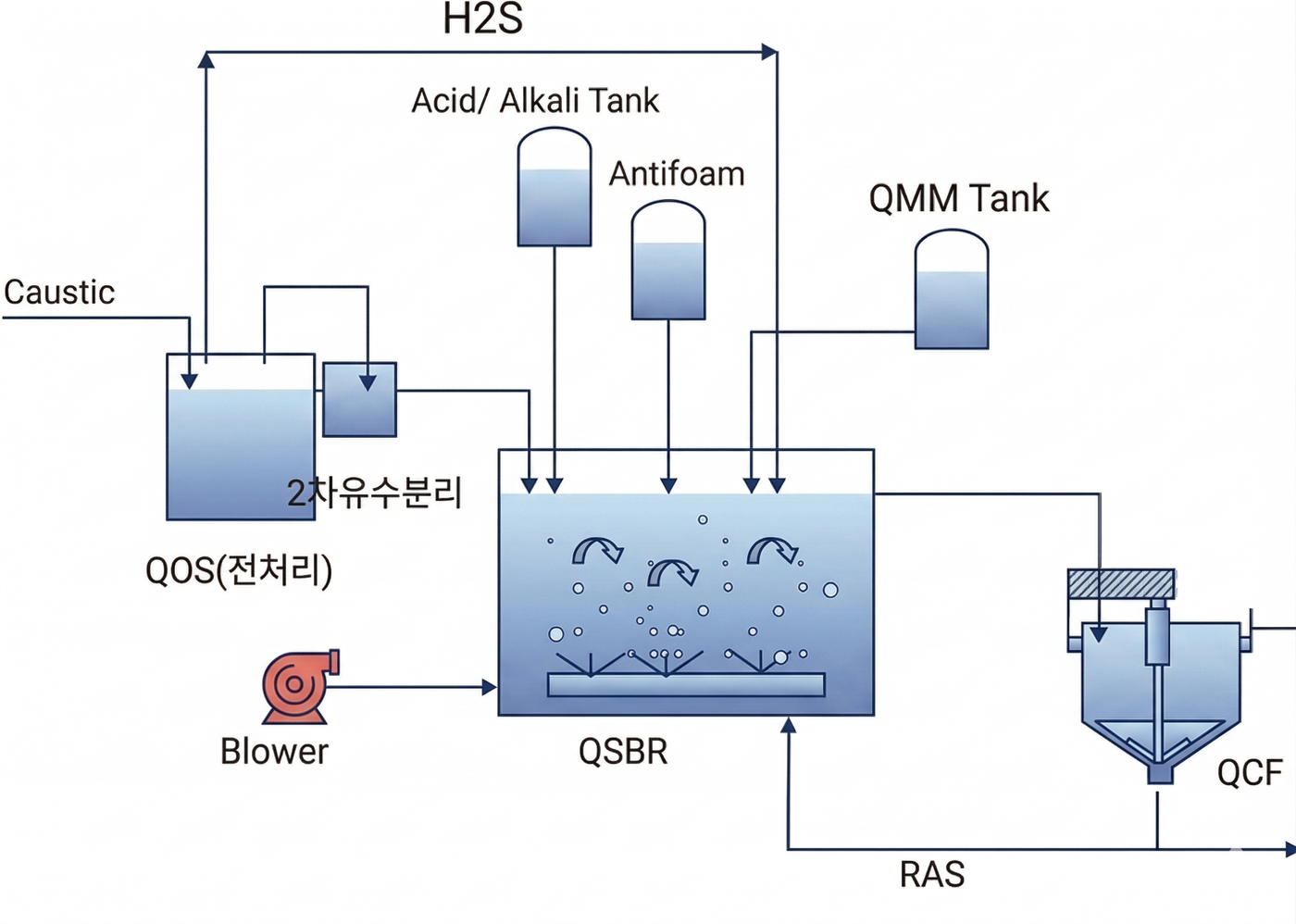
The High-Concentration Sulfur Wastewater Pretreatment System (QSBR SYSTEM) is a process that uses Q-BioTech's proprietary bacteria to economically treat sulfur-containing Spent Caustic wastewater generated from petroleum desulfurization processes.

QSBR SYSTEM — High-concentration sulfur wastewater pretreatment process flow diagram

Technology Overview

For target wastewater at CODcr 5.0–20 kg/m³·day and Sulfide 100–1,000 ppm, it achieves 90% organic matter removal and 95% S²⁻ removal efficiency. Neutralization is unnecessary, reducing H₂S generation, and WAO shutdown is possible, cutting operating costs.

What is Spent Caustic Wastewater?

Spent Caustic refers to the waste liquid generated when NaOH is used to remove sulfur compounds from crude oil during the desulfurization process. It is divided into refinery Spent Caustic and ethylene Spent Caustic. This wastewater contains high concentrations of S²⁻, SR, phenol, oil, and Naphthenic Acid, making it extremely difficult to treat.

The most commonly applied methods for treating Spent Caustic wastewater are WAO (Wet Air Oxidation) and biological treatment. WAO has the disadvantages of high operating costs and difficult stable operation, while in conventional biological treatment, S²⁻ acts as a toxic agent, making treatment challenging.

QSBR SYSTEM Application Results

  • Treatment of Spent Caustic-containing wastewater from gasoline and diesel desulfurization processes (strongly alkaline, high CODcr, containing large amounts of NH₃-N and Phenol)
  • Stable treatment of S²⁻ and COD confirmed after QSBR application — achieving 90% organic matter treatment efficiency and 95% S²⁻ removal efficiency
  • No neutralization required during QSBR operation → reduced H₂S generation
  • WAO (Wet Air Oxidation) shutdown possible during QSBR operation → significant reduction in operating costs
Wastewater Properties (Spent Caustic)
NO Diesel S/C Gasoline S/C
Diesel S/C Catalytic Gasoline S/C Gas Separation S/C
pH131313
S²⁻1,0025,345618
COD88,900360,000167,000
NH₃-N3,9574,1134,896
Phenol6,70280,88625,351
QSBR Application (After Treatment)
pH S²⁻ COD NH₃-N Phenol
6~9≤10≤1000≤30≤10

High-Concentration Saline Wastewater Pretreatment System

The QHBR SYSTEM is a process that uses Q-BioTech's proprietary bacteria to rapidly and economically treat high-concentration organic saline wastewater generated from chemical and manufacturing plants.

QHBR SYSTEM — High-salinity wastewater biological treatment process

Technology Overview

It effectively treats organic matter at target wastewater concentrations of 5,000–200,000 ppm CODcr and 10,000–80,000 mg/L TDS (NaCl). The patented microbial process enables biological treatment of high-salinity wastewater, and the elimination of dilution water reduces operating costs.

QHBR Technical Advantages

  • Minimized FootprintMinimized dilution water requirements — installation within existing site
  • Stable Effluent QualityStable water quality through pre/post-treatment integration
  • Proven TechnologyProven track record of stable high-salinity wastewater treatment
  • Reduced Operating CostsSignificant operating cost reduction through biological treatment
  • High Treatment EfficiencyOver 85% organic removal under high-salinity conditions (TDS 3.0–8.5%)
  • Low-Carbon Green TechnologyLower energy consumption compared to alternative technologies

What is High-Salinity Wastewater?

In chemical manufacturing processes where NaOH, HCl, and similar chemicals are used as raw materials, wastewater with high salt (NaCl) content is generated. Generally, high-salinity wastewater cannot be treated biologically, so physical-chemical treatment methods are widely applied.

Conventional high-salinity wastewater treatment relies on dilution and stripping, which requires large volumes of dilution water and incurs high operating costs. Additionally, when high-salinity wastewater enters treatment plants, it affects cytoplasmic synthesis and reduces floc formation, leading to decreased microbial activity.

QHBR SYSTEM Application Results

  • QHBR SYSTEM applied at a Yeosu petrochemical company
  • Stable treatment of COD and NH₃-N in saline wastewater confirmed after QHBR application
  • Significant reduction in operating costs by eliminating dilution water usage
Wastewater Properties
CODcr
[ppm]
NH4-N
[ppm]
Aniline
[ppm]
TDS
[g/L]
pH
Values6,0001002008,0009~11
QHBR Application
CODcr
[ppm]
NH4-N
[ppm]
Aniline
[ppm]
TDS
[g/L]
pH
Values2001020.05,0007~8