


QBF (Quick Bio Filter)
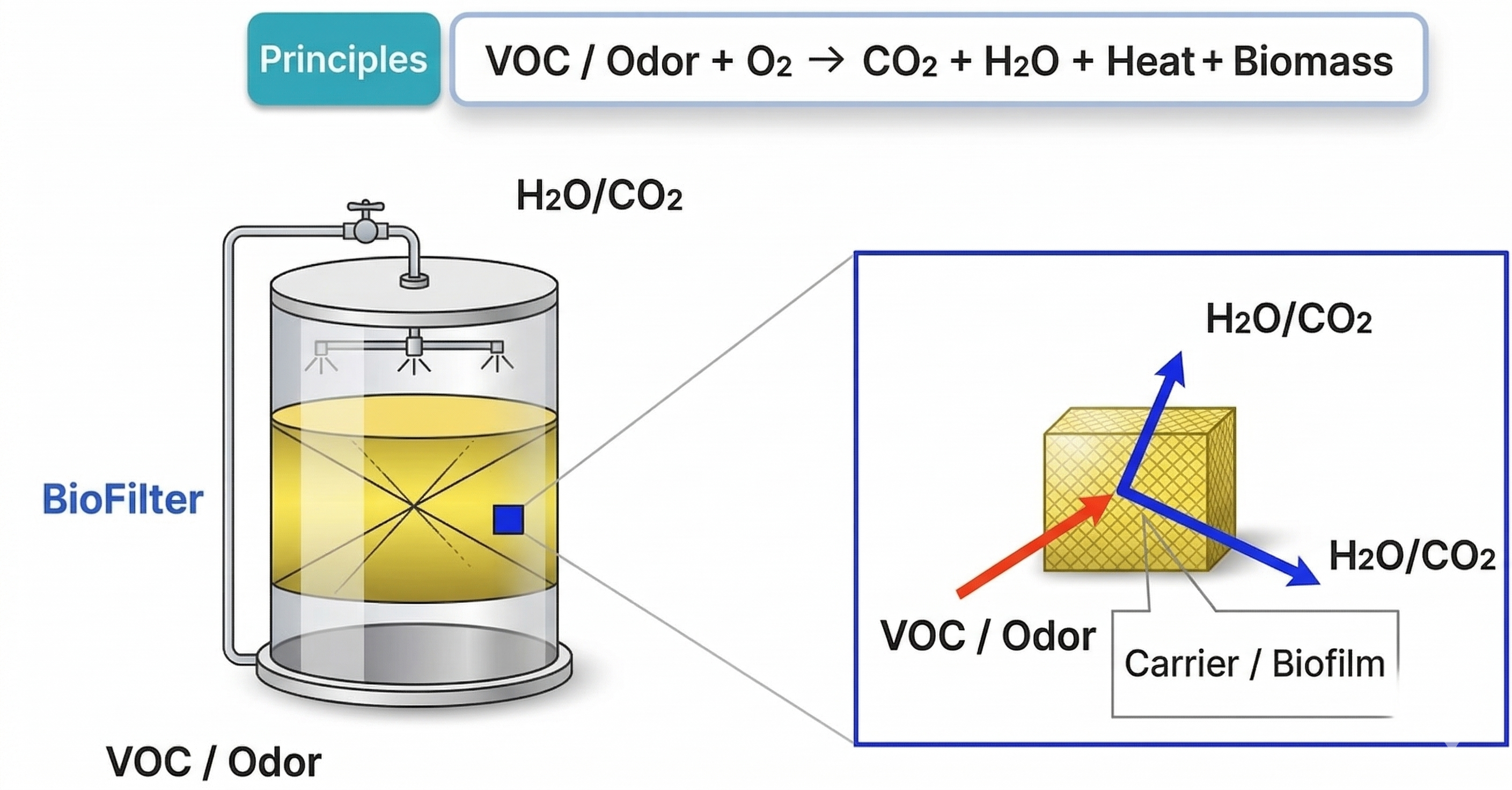
QBF decomposes VOCs (volatile organic compounds) and odorous substances into harmless, odor-free byproducts by passing them through a packing media bed colonized by Q-BioTech's proprietary microorganisms. The process operates with zero risk of fire or explosion.
Principle: VOC / Odor + O₂ → CO₂ + H₂O + Heat + Biomass
Mobile Odor Removal
Odor and hazardous gas emissions at industrial sites can be continuous, but more often they occur in concentrated bursts during maintenance shutdowns, tank opening operations, and temporary process changes.
Conventional odor and hazardous gas treatment requires large, permanent installations involving significant upfront investment in process modifications, piping, and site preparation. This makes it economically impractical for odor issues that last only a few weeks to months per year.
Q-BioTech has developed a mobile odor and hazardous gas removal system to meet these field demands, available as an equipment rental service.
Mobile Odor Removal System Overview
Q-BioTech's mobile odor removal system is a modular unit in container or skid-mounted configurations, designed for rapid on-site deployment to effectively treat odor and hazardous gases during the required period.
- Addresses high-concentration odor and hazardous gas from short-term events
- Immediately deployable without permanent facility construction
- Rapid demobilization after work completion
QBF System Configuration
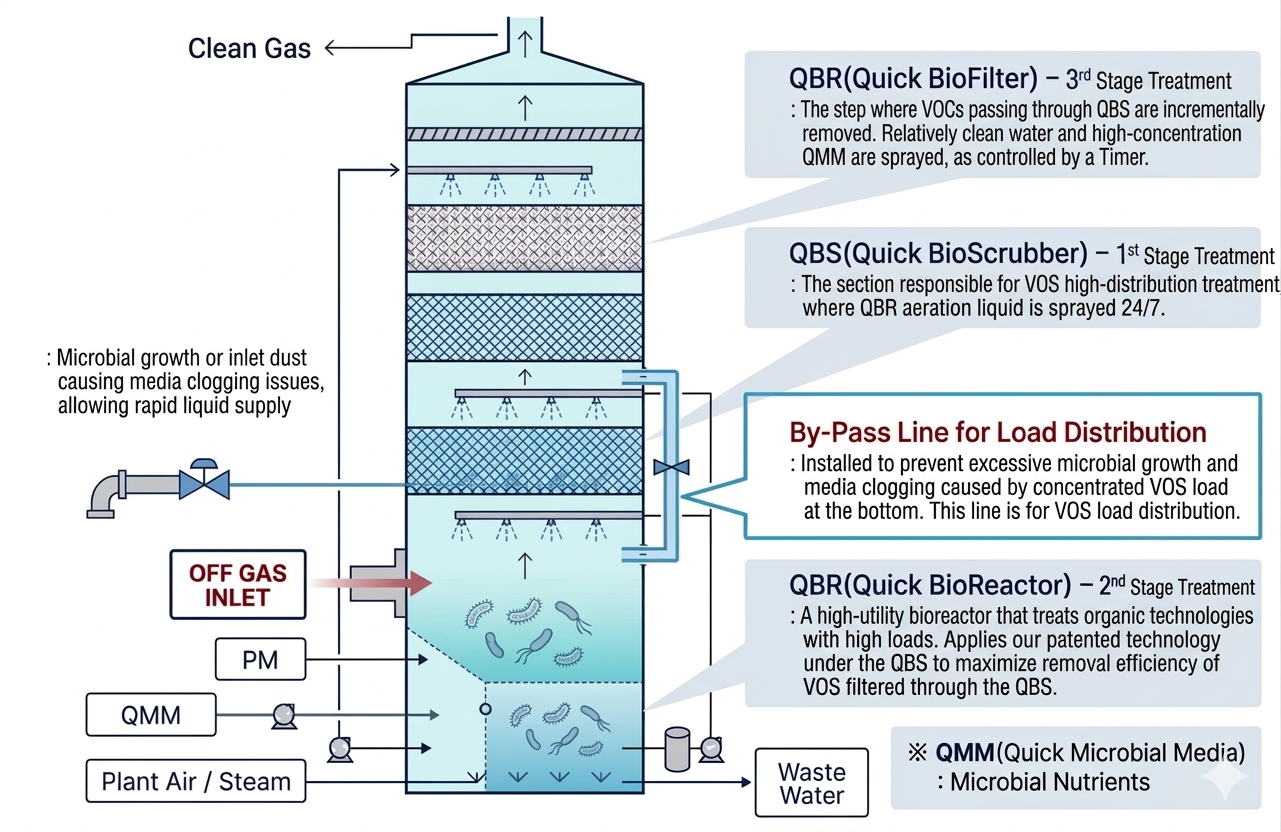
Technical Features (System Configuration)
- QBF (Quick BioFilter) — Tertiary Treatment: Final VOC treatment stage after QBS, where relatively clean water and high-concentration QMM are sprayed on a timer-controlled schedule
- QBS (Quick BioScrubber) — Primary Treatment: Handles high-load VOC treatment; QBR aeration liquid is sprayed continuously 24 hours
- Load-Balancing By-Pass Line: Installed to prevent microbial overgrowth and media bed clogging caused by VOC load concentration at the lowest packing layer
- QBR (Quick BioReactor) — Secondary Treatment: High-efficiency bioreactor for high-load organic treatment. Our patented technology applied below the QBS to maximize VOC removal efficiency
- QMM (Quick Microbial Media): Microbial nutrient supplement
Summary of QBF System
| QBF (BioFilter) | |
|---|---|
| Principle | Ambient temperature/pressure process where incoming VOCs and odorous compounds pass through a media bed inhabited by microorganisms that use them as a food source |
| Safety | Operates at ambient temperature and pressure with no pressurization; water-based process eliminates all risk of fire or explosion |
| Secondary Pollution | Decomposes into CO₂ and H₂O, requiring no additional measures even under stricter future regulations. Small volumes of general wastewater are generated and easily treated |
| Operability | Requires no special management beyond daily monitoring points. Can be handled by general operators without specialized knowledge as part of routine duties. Standard components (pumps, blowers, piping) are easily replaceable if damaged |
| Operating Cost | Favorable (uses microbial nutrient media) |
| Application Range | Applicable from low-concentration and irregular emissions to high-concentration ranges; particularly advantageous for high-airflow environments |
QBF System Overview

※ The above diagram shows a QBF System with an integrated QVE (VOC load equalizer)
(FAN / QBF Circulation Pump / Control Panel / QVE Circulation Pump)
QBF Treatable Substances
※ Degradability: +++ Excellent / ++ Good / + Moderate
Aliphatic Hydrocarbon
- Methane +++
- Pentane +
- Isopentane +
- Hexane ++
- Cyclohexane +
- Acetylene +
Aromatic Hydrocarbon
- Benzene ++
- Phenol +++
- Toluene +++
- Xylene ++
- Styrene Monomer +++
- Ethylbenzene +++
Oxygenated Carbon
- Methanol +++
- Ethanol +++
- IPA +++
- Butanol +++
- 2-Butanol +++
- 1-Propanol +++
- 2-Propanol +++
- Formaldehyde +++
- Acetaldehyde +++
- Acetic acid +++
- Butyric acid +++
- Vinyl acetate +++
- Ethyl acetate +++
- Butyl acetate +++
- Isobutyl acetate +++
- Diethyl ether +
- Dioxane +++
- MTBE +++
- Tetrahydrofuran +++
- Acetone +++
- MEK +++
- MIBK +++
Chlorinated Hydrocarbon
- Carbon tetrachloride +
- Chloroform +
- Dichloromethane (MC) ++
- Tetrachloroethane +
- Trichloroethane +
- Vinyl Chloride +
- Chlorotoluene +
Nitrogen-Containing Carbon
- Amine +++
- Aniline +++
- Nitriles +
- Acrylonitrile (AN) ++
- Pyridine ++
- Dimethylformamide +++
Sulfur-Containing Carbon
- Carbon disulfide ++
- Dimethyl sulfide ++
- Dimethyl disulfide ++
- Methyl mercaptan +
- Thiocyanates +
Inorganic Compound
- Ammonia +++
- Hydrogen sulfide +++
- Nitrogen oxide +
QVE (Quick VOCs Load Equalizer)
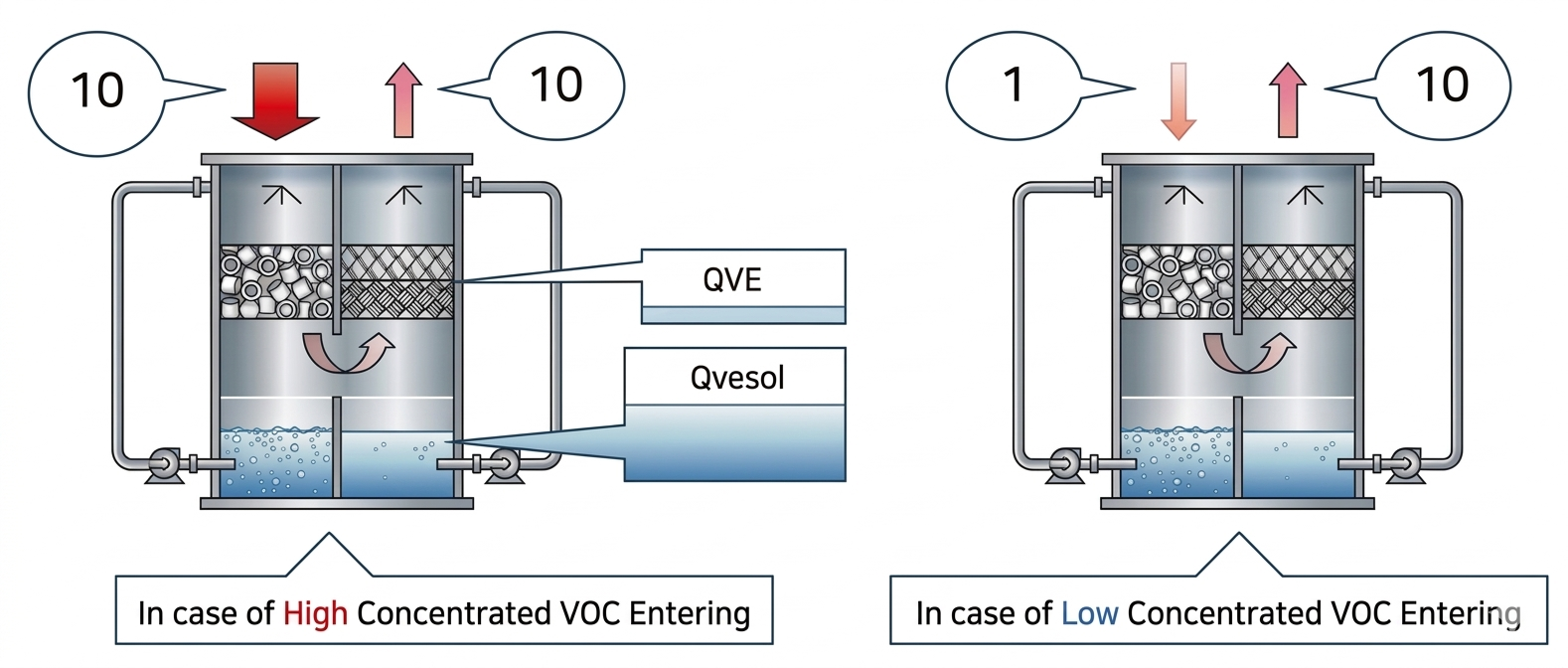
QVE captures and stores VOCs (volatile organic compounds) generated intermittently from processes, then releases them at a consistent concentration to enable stable operation of downstream treatment equipment. It is ideal for facilities with discontinuous or high-concentration VOC emissions.
QVE Operating Principle
A non-volatile organic solvent (Qvesol) repeatedly absorbs and desorbs VOCs according to concentration equilibrium, delivering a consistent VOC concentration to downstream treatment systems (RTO or BioFilter).
It captures VOCs at thousands to tens of thousands of ppm, then continuously releases them within a controlled concentration range — reducing peak concentrations and maintaining a steady 24-hour output.
By reducing peak concentrations and maintaining steady 24-hour output:
- Reduced capital investment
- Lower operating costs
- Reliable treatment performance
- Elimination of fire and explosion risk
Target Facilities
Facilities with discontinuous, high-concentration VOC and odor emissions:
- VOC storage tanks at petrochemical complexes
- Tank truck product loading stations
- Other facilities with batch or intermittent production processes
- Existing treatment systems (biofilter, RTO, etc.) struggling with unstable inlet concentrations